
How to successfully deal with lower back pain from sitting at a computer
Long hours spent sitting at a computer will sooner or later take their toll on our health, with the most common warning sign being a dull, persistent, or sharp pain in the lower back area. This problem affects not only programmers, graphic designers, and administrative workers, but anyone whose daily routine revolves around an office chair. A sedentary lifestyle causes the muscles around the pelvis and spine to weaken, shorten, and lose their ability to properly perform their stabilizing function. If we want to permanently get rid of lower back pain, it is not enough to rely only on occasional massages or pain-relieving medications. It is necessary to approach a comprehensive change that combines targeted core strengthening, effective stretching, and adjustment of daily habits.
Why does your lower back hurt when sitting?
The human body was not created to spend ten hours a day in an unnatural bent position in front of a monitor. When we sit, the abdominal muscles and the deep stabilizing system of the spine weaken. The muscles on the front of the thighs and in the hip area, especially the iliopsoas muscle, on the other hand, shorten. This imbalance pulls the pelvis forward and down, creating excessive lumbar lordosis – a curvature in the lower back. The lumbar vertebrae are then exposed to undue pressure, the intervertebral discs suffer, and the surrounding muscles spasm to hold the spine together. The result is chronic pain that radiates into the buttocks or thigh.
Key to relief: Strengthening the core and lower abdomen
The cornerstone in the fight against lower back pain is a strong abdominal muscle apparatus. Many people think that abdominal exercises mean endless classic crunches. However, these often strain the cervical and lumbar spine and rarely effectively engage the deep layers. To protect the lower back, it is crucial to focus on the lower abdomen, which directly stabilizes the pelvis and prevents its incorrect rotation.
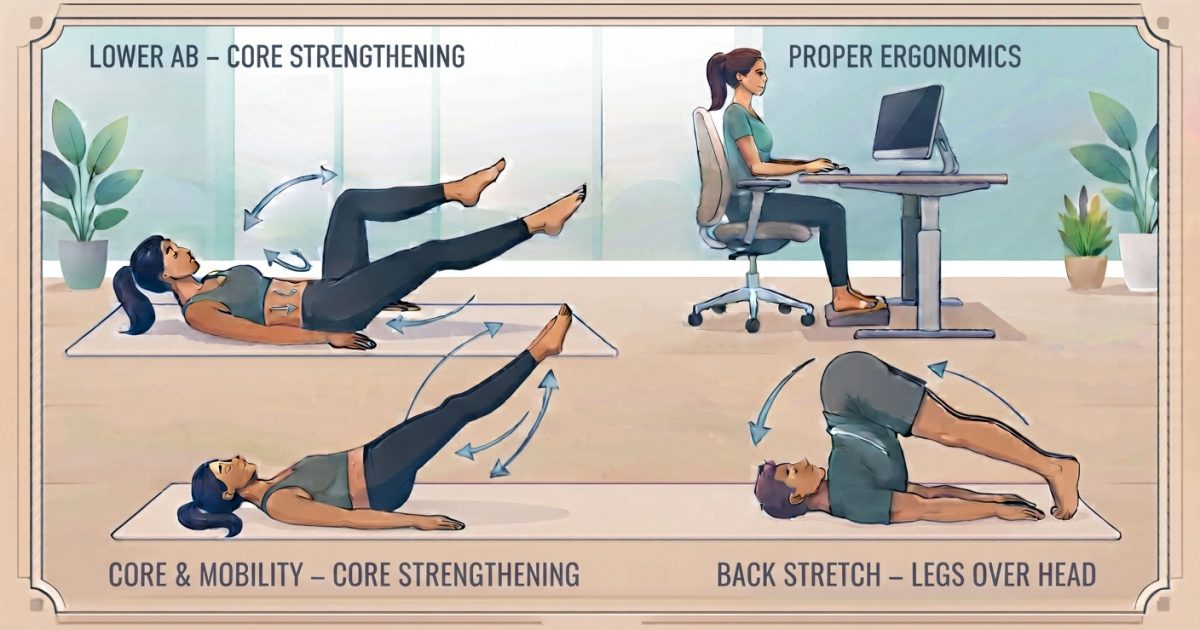
A great exercise for this area is leg raises lying on your back. Lie on a mat, place your hands loosely along your body or under your buttocks for better support of the lumbar spine. As you exhale, lift both straight or slightly bent legs towards the ceiling and slowly lower them back down without your heels completely touching the floor. The most important rule is to press your lower back firmly to the mat throughout the movement. If your lower back lifts off, it means that the strength of your lower abdomen is not yet sufficient, and it is better to initially alternate one leg, or bend your legs less. Regular repetition of this exercise builds a strong corset that will support your lower back even during long periods of sitting.
Complex movement: Leg swings to the sides for abs and stability
Another highly effective movement that combines abdominal strengthening with pelvic release is leg swings to the sides while lying down. This exercise functions as a multifunctional tool for your body. When you lie on your back and consciously control the movement of your lower limbs to the sides, you strongly engage the oblique abdominal muscles and the deep stabilizing system, which again leads to effective abdominal strengthening without the need to strain your neck.
For this exercise, lie on your back, spread your arms for stability, and lift your legs into the air with bent knees at a right angle, or keep them straight for greater difficulty. Then slowly lower your joined legs to one side towards the ground without lifting the opposite shoulder. Stop just above the floor and use the strength of your abdominal muscles to return your legs to the center, then repeat on the other side. This rotational and lateral movement not only strengthens the abdomen but also excellently mobilizes the thoracic and lumbar spine, relieves tension in the lower back, and helps correct muscle imbalance caused by one-sided sitting.
Relieving stiff back: Stretching legs behind you
In addition to strengthening the abdomen, it is necessary to pay attention to the stretching of overloaded and shortened posterior structures themselves. An excellent method to relieve compressed vertebrae is stretching the back by putting the legs behind you while lying down. This movement is derived from yoga positions and brings immediate relief from pressure in the lumbar region.
To perform this exercise, lie on your back on a mat. Inhale and, using your abdominal muscles, lift your legs over your torso and slowly let them fall behind your head, trying to reach the floor behind your head with your toes. You can leave your arms extended on the mat or support your back with them. This exercise perfectly decompresses the entire spine, gently stretches the intervertebral spaces, and relieves tension in the entire posterior chain from the calves through the hamstrings to the neck. It is important to breathe calmly and deeply and never force yourself into the position, especially if you are stiff. After a few breaths, slowly return to the starting position on your back, vertebra by vertebra.
Ergonomics and daily habits as prevention
However, exercise alone is not enough if you spend eight hours at work in an unsuitable position on a bad chair. It is important to adjust your work environment:
- Adjust the height of your desk and chair so that your feet rest flat on the floor and your knees are at a right angle or slightly greater.
- Position the monitor so that its top edge is at eye level, which will prevent you from leaning your head forward and subsequent tension chaining into your entire back.
- Regularly interrupt sitting. Every thirty to forty minutes, stand up, walk around, stretch, and relax your pelvis.
- Include targeted core strengthening and compensatory exercises in your weekly schedule at least two to three times a week.
Fighting lower back pain from sitting requires patience and a systematic approach. By combining lower abdominal strengthening, dynamic leg swings to the sides, and deep back stretching, you will restore your body's natural balance. Your spine will quickly thank you for this care with relief and a return to pain-free movement.