
Losing weight and then maintaining it is a constant struggle for some. And as in every struggle, there are situations where you are not the one on top. But the question is, what to do when you try hard enough, don't eat too much, but still seem to have hit a certain level beyond which it seemingly can't go?
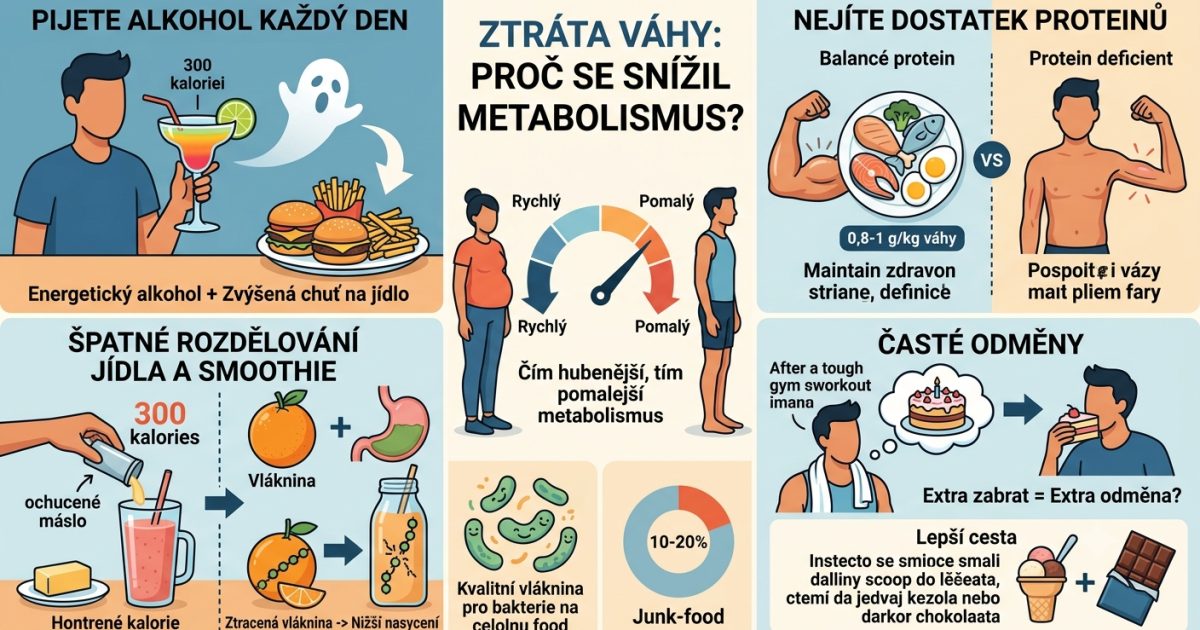
But you don't have to despair, it's completely normal, because the thinner you are, the more your metabolism slows down, so the more work it then requires. With a smaller body, you also need to eat less, so that's one way, the other is to burn it the old-fashioned way.
You drink alcohol every day
Your favorite cocktail can have more calories than it seems. For example, a good old Margarita can have up to 300 calories. And besides, alcohol is also energetic, not to mention the fact that it subtly increases your appetite a bit – people who received a placebo ate the same volume and those with two drinks ate 30% more.
You don't eat enough protein
As you lose weight, you lose muscle along with fat, so it's important to maintain them. Your protein intake should be 0.8-1 g per 1 kg of your body weight.
You don't portion your food correctly
Many people who exercise and try to lose weight devalue the importance of proper portion sizes.
Maybe you add a few spoonfuls of something more interesting to your smoothie (flavored butter or other fat with a few proper spoonfuls will add 120 calories a day and thus 840 a week!), generally avoid smoothies always when losing weight: you destroy insoluble fiber here, which holds the soluble one in water, so you digest everything and thanks to zero fiber, the whole part is digested by the body and does not get where it should: into your small intestine. Good bacteria here require good food!
The more fiber you eat, the better for the cells below and the more of that food (even 10-30% easily) is eaten by bacteria and not your body!
You often treat yourself to something special
What's the problem if you have one small cake after exercise, right? This approach can destroy all your efforts, because what you painstakingly lost you immediately gain back.
When a person works extra hard, they usually have a subconscious desire to subconsciously reward themselves well for it. In the end, if you have a piece of candy with 500 calories a few times a week, that's 6,000 calories a month.
Instead of such things, rather reward yourself with one scoop of quality vanilla ice cream or a bar of dark chocolate every day.
Most people don't meet this by any chance, but only about 10-20% of energy intake should come from junk food. So when you get a craving for something, try to limit it to 10% of your daily intake: if you eat 2800 calories a day, you can have a maximum of 280 calories.
You think you are more active than you really are
When you start exercising more, you encounter something called “compensatory inactivity” – meaning that while you exercise more than usual, you move less as a result.
Most people do this – they work out in the morning, but when they come home, they sit on the couch and turn on their PC or Netflix, because they feel they have done enough for today. So even after exercise, move a little: walks, regular walking and running up the stairs in the apartment building, …